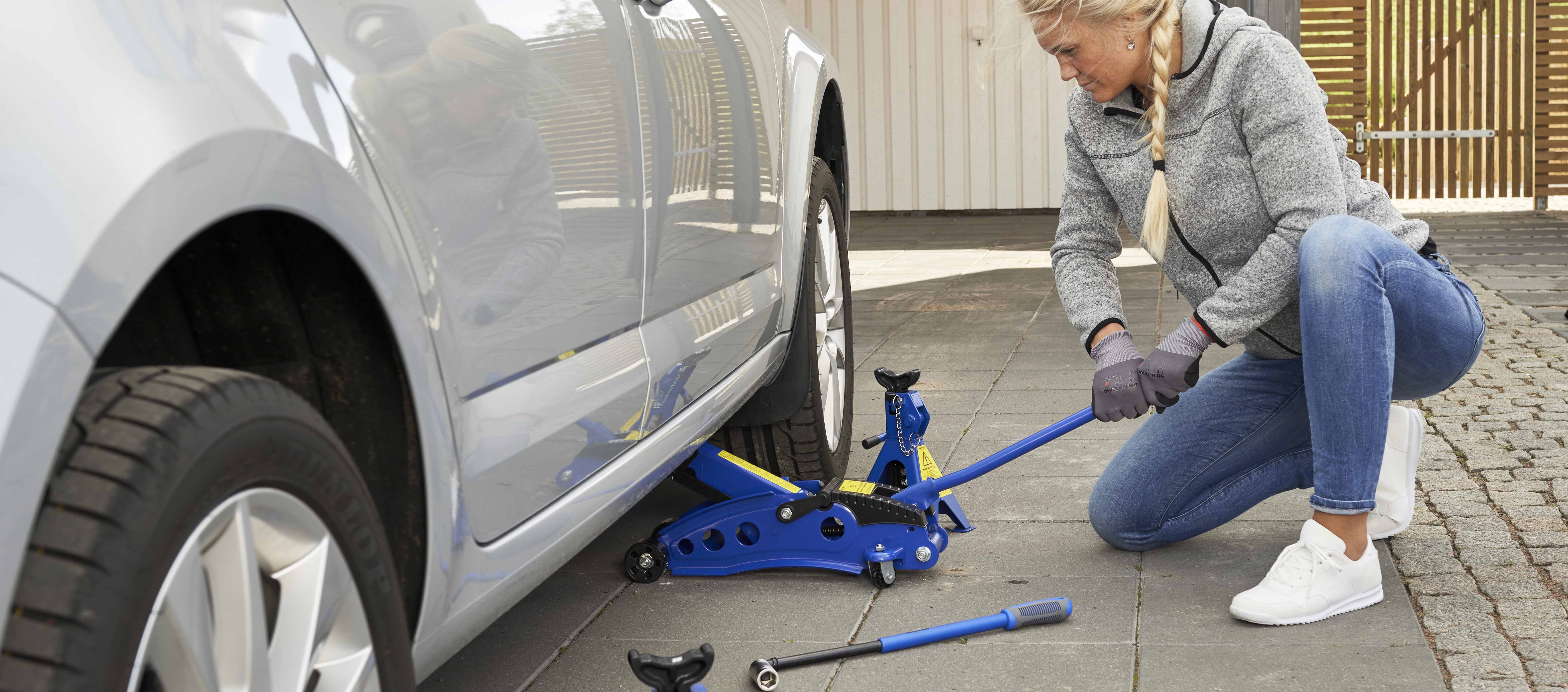
How to use the jack correctly
Preparation: The right place and securing
Before you use the jack, you need to make sure the conditions are right.
- The surface: Always work on a flat and hard surface, such as concrete or asphalt. Soft ground (grass/gravel) can cause the jack to sink or tip over.
- Gear & Brake: Apply the handbrake firmly and shift into first gear (or position P on automatic cars).
- Chocks: Place the chocks in front of and behind the wheels that are to remain on the ground. This prevents the car from rolling off the jack during lifting.
Find the right lifting point
Cars have specific points in the chassis that are reinforced to withstand the weight of a lift.
- Check your car's owner's manual: Never lift out of feeling. Incorrect placement can damage thresholds, floors or, in the worst case, lead to the car sliding off.
- Centering: Make sure that the jack lifting saddle (the round bowl) is centered directly below the lifting point of the car.
The main rule: Never go under without pallet trestles
This is the most important point of the entire guide.
WARNING: Never rely solely on the hydraulics of a jack. A gasket can burst without warning, causing the car to fall in a fraction of a second.
- Secure with trestles: As soon as the car has reached the desired height, place trestles under approved support points.
- Lower gently: Slowly lower the jack until the weight of the car rests firmly on the pallet jacks. Leave the jack in place as an extra safety measure, but make sure that it is the trestles that carry the weight.
After work: Lowering
When you are done and need to get the car back down on the ground:
- Lift the car up a couple of centimetres with the jack so that you can remove the pallet jacks.
- Make sure that no tools or people are under or near the car.
- Open the jack valve very slowly. A quick lowering can damage the car's suspension or cause the car to jump.